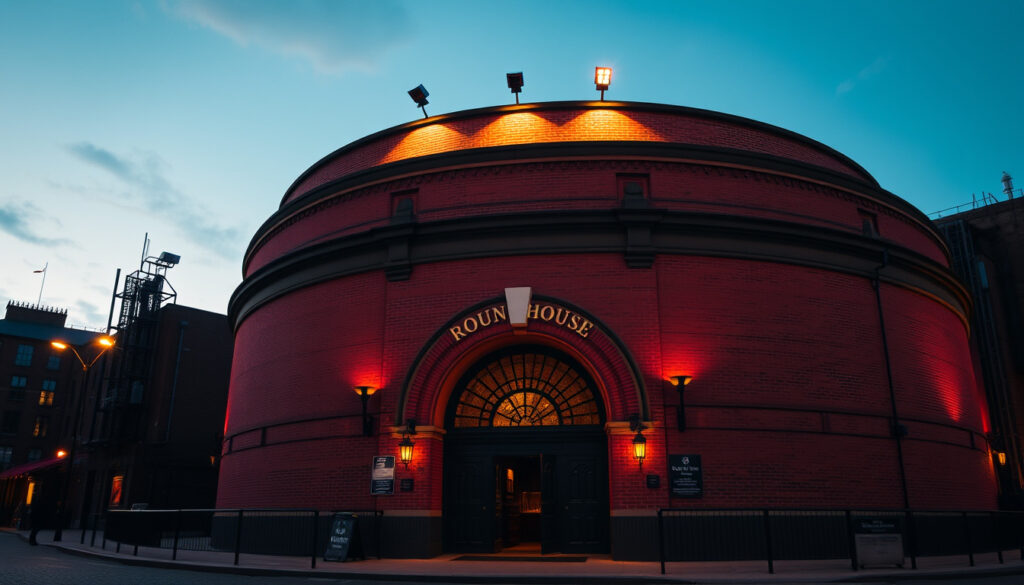
In the Roundhouse – Complete Guide to London’s Camden Venue
The Roundhouse stands as one of London’s most architecturally distinctive and culturally significant venues, a Grade II-listed Victorian building that has witnessed remarkable transformations since its construction in 1846. Nestled on Chalk Farm Road in Camden, NW1 8EH, this circular structure originally served as a steam engine repair shed before evolving through various incarnations into what it is today: a thriving performing arts centre that bridges the capital’s rich musical heritage with contemporary creative programming.
From its heady days as the heart of Britain’s counterculture movement during the 1960s and 70s to its modern incarnation as a space for music, theatre, circus, and innovative creative projects, the Roundhouse has repeatedly reinvented itself while preserving its unique architectural character. Visitors drawn to the venue today encounter the same vast iron pillars and expansive roof that once accommodated some of rock history’s most legendary performances, now serving a new generation of artists and audiences seeking an intimate yet historically resonant experience.
What Is the Roundhouse and Why Does It Matter?
Camden, London
Chalk Farm Road
~600 attendees
Main Auditorium
Arts & Music Venue
Grade II Listed
Active Venue
Since 2006
The Roundhouse occupies a singular position in British cultural history. Its circular architecture, originally designed to accommodate locomotive turntables, creates an intimate yet grand atmosphere that has drawn both performers and audiences for decades. Unlike purpose-built concert halls, the venue’s industrial heritage remains visible in every performance, a living monument to London’s engineering past.
Several characteristics distinguish the Roundhouse from other London venues:
- Its status as a Grade II-listed building means original features including cast iron pillars and the expansive roof structure are legally protected, ensuring the venue retains its historic character
- The venue served as the epicentre of Britain’s counterculture movement during the 1960s, earning comparisons to San Francisco’s Fillmore West
- After standing derelict for 23 years following its 1983 closure, a £40 million restoration returned the building to active use in 2006
- Programming spans multiple disciplines including live music, contemporary theatre, circus arts, and creative development schemes for emerging artists
- The thrust-stage configuration introduced during the 1979 Jude Kelly revamp created an intimate connection between performers and audiences
- Its Chalk Farm location places it within one of London’s most vibrant cultural neighbourhoods
- Historic acts including Led Zeppelin, Pink Floyd, Jimi Hendrix, and The Who performed memorable shows within its walls
| Fact | Detail |
|---|---|
| Original Construction | 1846 as London and Birmingham Railway engine maintenance shed |
| Address | Chalk Farm Road, Camden, London NW1 8EH |
| Current Capacity | Approximately 600 for main auditorium events |
| Listing Status | Grade II-listed Victorian structure |
| Music Venue Opening | October 15, 1966 with Pink Floyd and Soft Machine |
| Current Operators | Roundhouse Trust |
| Latest Restoration | 2006, £40 million+ renovation by John McAslan + Partners |
| Nearest Underground | Camden Town and Chalk Farm stations |
A Timeline of the Roundhouse’s Remarkable History
The Railway Years and Warehouse Era
The building that would become the Roundhouse was constructed in 1846 as a steam engine repair shed for the London and Birmingham Railway, designed with the characteristic circular shape to accommodate locomotive turntables. By the 1860s, the structure had already been repurposed as a corn and potato storage facility, marking the first of many transformations in its history.
Between 1869 and 1963, W. & A. Gilbey Ltd. leased the space as a bonded warehouse for wines, spirits, and maturing whisky and brandy. During this period, railway tracks were removed and a wooden gallery with loading bay added, fundamentally altering the interior configuration while the building lay dormant in its primary purpose. This long commercial tenure preserved the structure while delaying its cultural emergence.
The Counterculture Hub Emerges
After Gilbey’s departure in 1964, the empty building attracted the attention of playwright Arnold Wesker, who proposed converting it into Centre 42, an arts centre backed by Trades Union Congress Resolution 42. Technical challenges including cast iron pillars that blocked sightlines and poor acoustics for theatre persisted, but the venue finally opened under manager Andrew Hoskins in 1966 with an “open door” policy that welcomed the emerging counterculture movement.
The inaugural event on October 15, 1966—an all-night rave featuring Pink Floyd and Soft Machine to celebrate the launch of the International Times underground newspaper—signalled the venue’s intent to become something extraordinary. By 1967, the Roundhouse hosted The Doors, Jimi Hendrix, and The Who alongside underground clubs including UFO Club and Middle Earth, while the July Dialectics of Liberation conference brought figures including Allen Ginsberg, Stokely Carmichael, Angela Davis, and R.D. Laing for intellectual exchange as intense as the musical performances.
The 1979 revamp under Jude Kelly transformed the space into a thrust-stage auditorium inspired by Manchester’s Royal Exchange Theatre. This architectural decision, which reduced capacity from 940 to approximately 600, created the intimate performer-audience relationship that defines the venue’s modern identity. Vanessa Redgrave’s appearance in Ibsen’s The Lady from the Sea marked the inauguration of this new era.
Visiting the Roundhouse Today
Practical Information for Modern Visitors
Reaching the Roundhouse by public transport proves straightforward, with the venue situated in a well-connected area of Camden. Both Camden Town and Chalk Farm Tube stations serve the Northern line, placing the venue within easy reach from central London and beyond. Multiple bus routes also serve the Chalk Farm Road area, making the venue accessible from across the capital without relying on private vehicles.
Parking presents greater challenges. The surrounding Camden area experiences significant congestion and limited street parking availability. Visitors travelling by car should consider nearby paid parking facilities or, where possible, opt for public transport to avoid the stress of searching for spaces. The venue’s central location makes it well-suited to combining with other activities in Camden’s vibrant neighbourhood.
Accessibility and Facilities
The 2006 restoration significantly improved accessibility features throughout the venue. Wheelchair users and those with reduced mobility will find improved facilities compared to earlier incarnations, though the historic nature of the building means certain areas may retain architectural challenges. Prospective visitors with accessibility requirements are encouraged to contact the venue directly to discuss specific needs ahead of events.
What to Expect at Events
The Roundhouse operates standard venue policies familiar to concert and theatre-goers. Age restrictions apply to certain events, particularly late-night performances, and bag searches may be conducted at entry points. Re-entry policies for gig events typically prevent audience members from leaving and returning during performances. Ticket purchasing operates through the box office and online channels, with prices varying according to event type and artist profile.
Popular events sell out quickly given the venue’s relatively modest capacity. Booking tickets promptly after they become available provides the best chance of securing seats or standing places. The Roundhouse’s intimate scale means that even performances by established artists occur in a far more personal setting than arena shows.
The Roundhouse’s Place in Music and Theatre Culture
Legendary Performances and Historic Gigs
The Roundhouse earned its reputation as “England’s Fillmore West” during a remarkable period in the late 1960s and 1970s when it hosted performances that have since become the stuff of musical legend. Promoter John Curd described it as “the best of its kind in London”, and the venue’s roster of performers during this period reads like a who’s who of rock and counterculture history.
Led Zeppelin’s first official London show took place at the Roundhouse on November 9, 1968, following their Scandinavian tour and renaming from The New Yardbirds. The band was still establishing their identity when they played the venue, and Robert Plant famously claimed his honeymoon took place there after his morning wedding. Whether apocryphal or accurate, such stories speak to the venue’s mythology within rock history.
Kenneth Tynan’s nude revue Oh! Calcutta! arrived at the venue in 1969, pushing boundaries in theatre as rock acts did in music. The venue hosted touring productions, experimental theatre companies, and regional companies alongside its music programming, creating a programming diversity that anticipated the multidisciplinary approach of today.
The Theatre-Music Tensions
The 1970s brought increasing tensions between weekday theatre productions and weekend rock events. Noise complaints from neighbours affected plans for shows such as XTC’s intended 1978 performance, which was moved due to these constraints. Ultimately, these tensions led to rock music being effectively evicted from the venue in 1978, a decision that marked the beginning of the end for the venue’s first chapter as a music venue.
Following the Arts Council’s withdrawal of funding in 1982 due to insufficient Camden Council support, the venue closed as a performing space in 1983. What followed was 23 years of dereliction, during which the building was considered for various alternative uses including a sports arena and an RIBA library, none of which materialised.
Key Milestones at the Roundhouse
- 1846 – Constructed as a steam engine repair shed for the London and Birmingham Railway
- 1869–1963 – Leased to W. & A. Gilbey Ltd. as a bonded warehouse for wines and spirits
- October 15, 1966 – Opens as music and theatre venue with Pink Floyd and Soft Machine all-night event
- 1967 – Hosts The Doors, Jimi Hendrix, The Who; Dialectics of Liberation conference
- November 9, 1968 – Led Zeppelin’s first official London show
- 1969 – Stages Kenneth Tynan’s Oh! Calcutta! nude revue
- 1979 – Jude Kelly’s refurbishment creates thrust-stage auditorium
- 1983 – Closes as performing venue following funding withdrawal
- 1983–2006 – Derelict for 23 years with failed proposals for alternative uses
- June 2006 – Reopens after £40m+ restoration; Paul Weller, The Who perform at reopening
What We Know for Certain vs. What Remains Unclear
Understanding the Roundhouse requires distinguishing between well-documented facts and areas where information remains incomplete or disputed.
| Established Information | Areas of Uncertainty |
|---|---|
| The building was constructed in 1846 as an engine maintenance shed | Specific details about the architects responsible for the original 1846 structure |
| Led Zeppelin performed their first official London show there in November 1968 | Exact circumstances of Robert Plant’s reported honeymoon claim and whether it occurred at the venue |
| The 2006 restoration cost exceeded £40 million | Detailed current ticket pricing structures and specific event programming beyond the general categories |
| Current capacity stands at approximately 600 following the 1979 reduction | Precise parking availability and whether dedicated accessible parking exists |
| The venue is Grade II listed and retains original iron pillars and roof structure | Specific upcoming events and programming details for 2025 beyond general venue programming |
| Sources consistently document the venue’s role as a counterculture hub from 1966 | Whether any 2025-specific events or anniversaries are being planned |
The Roundhouse and Camden’s Cultural Landscape
The Roundhouse exists within one of London’s most culturally rich neighbourhoods. Camden has long been associated with alternative music, art, and fashion, from its famous market to its network of venues and clubs. The Roundhouse’s presence in Chalk Farm contributed to this reputation during the 1960s and continues to anchor the area’s cultural identity today.
Its proximity to other significant Camden venues and cultural spaces created a circuit that drew visitors seeking experiences unavailable elsewhere in Britain. This geographical clustering proved mutually reinforcing, with the Roundhouse’s prestige attracting audiences who would explore other Camden establishments, and vice versa.
The venue’s survival through periods of dereliction and reopening demonstrates both the challenges facing historic venues in London and the enduring public value placed on preserving such spaces. The Roundhouse Trust’s stewardship since 2006 represents an ongoing commitment to maintaining the venue’s place within Camden’s cultural infrastructure, ensuring that future generations can experience performances within a space that has witnessed so much musical and theatrical history.
What Critics and Visitors Say
The Roundhouse has attracted commentary from promoters, musicians, and cultural commentators throughout its history, with praise consistently emphasising the venue’s unique atmosphere and historical significance.
“The best of its kind in London.”
— John Curd, music promoter, speaking about the Roundhouse’s position among UK venues
Contemporary reviews emphasise the venue’s nostalgic appeal and the character preserved despite renovations. Visitors attending modern performances frequently note the distinctive atmosphere created by the surviving Victorian architecture—the iron pillars, the vast roof, the circular configuration—elements that distinguish the experience from purpose-built modern venues.
Historical accounts from the counterculture era describe the venue in terms approaching reverence. The “hippy heaven” characterisation reflects not merely the music performed but the atmosphere cultivated by the “open door” policy and the building’s remarkable interior. For those who experienced the venue during its peak years, performances at the Roundhouse represented something beyond ordinary concerts.
“An unforgettable venue for gigs, with a character that remains intact despite the closures and renovations.”
— Contemporary visitor reviews, reflecting sustained appreciation for the venue’s unique qualities
Is the Roundhouse Worth Visiting?
The Roundhouse remains a venue that rewards those who seek it out. Its modest capacity creates an intimate experience impossible to replicate in larger venues, while the preserved Victorian architecture provides an atmospheric backdrop that enhances performances across all programming disciplines. The venue’s location in vibrant Camden makes combining a visit with exploration of the neighbourhood straightforward and appealing.
Whether attending a contemporary music performance, theatre production, circus act, or one of the venue’s creative programmes, visitors encounter a space that carries genuine historical weight. The same iron pillars that challenged early theatre productions now support performances by artists who may themselves become the subjects of future historical accounts. For those interested in experiencing where significant musical and cultural moments have occurred, the Roundhouse continues delivering performances worth remembering.
Those seeking to understand more about cultural venues and their place in music history will find the Roundhouse an instructive case study in how spaces evolve while retaining their essential character.
Frequently Asked Questions
Where is the Roundhouse located?
The Roundhouse sits on Chalk Farm Road in Camden, London, NW1 8EH, near the Chalk Farm and Camden Town Tube stations.
What is the Roundhouse’s current capacity?
The main circular auditorium now holds approximately 600 people for seated or standing events, reduced from its original 940 during the 1979 refurbishment.
When did the Roundhouse originally open as a music venue?
The Roundhouse opened as a music and theatre venue on October 15, 1966, with an all-night event featuring Pink Floyd and Soft Machine.
Is the Roundhouse wheelchair accessible?
Wheelchair access was significantly improved during the 2006 restoration and renovation works.
How much does it cost to visit the Roundhouse?
Ticket prices vary by event. Standard venue ticketing operates through the box office and online channels. Check the official website for current pricing.
What types of events does the Roundhouse host?
Today the venue hosts live music performances, theatre productions, circus acts, and creative programmes across multiple spaces.
Why is the Roundhouse considered historically significant?
The Grade II-listed Victorian structure was built in 1846 and became the epicentre of UK counterculture in the 1960s, hosting legendary acts like Pink Floyd, Jimi Hendrix, and Led Zeppelin.
Can I park at the Roundhouse?
Limited street parking is available in busy Camden. Visitors are advised to use public transport or nearby paid parking facilities.
More related posts
 Karl Lagerfeld: Full Biography, Legacy & Brand Guide
 Saoirse Ronan: Age, Husband, Movies, Pronunciation & FAQs
 Finn Bennett: Age, Nationality, Movies, TV Shows & Personal Life
 Gervonta Davis: Undefeated Record, Next Fight & Retirement Rumors
 Brodie Harper: TV Presenter and Chemist Warehouse Face
 Kung Fu vs Karate: Differences, History & Difficulty
 Quilt Cover Sets Ireland: Sizes, Stores & Buying Guide
 Top Programming Tutorials: Reddit, GitHub & Beginner Picks