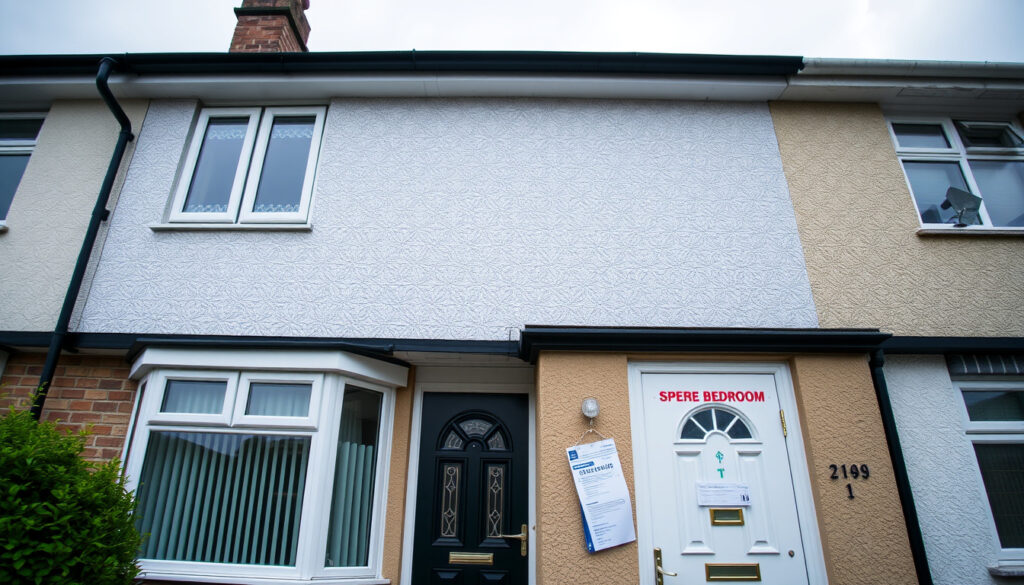
UK’s Spare Bedroom Tax: Rates, Exemptions Explained
If you have a spare room gathering dust, two very different governments see it as either a welfare problem or a money-making opportunity. The UK’s “bedroom tax” docks housing benefit from social tenants with unused space, while Ireland offers tax-free income up to €14,000 a year for those willing to rent theirs out. The gap between these approaches is stark — and for anyone navigating either system, understanding the rules matters more than the rhetoric.
UK reduction for one spare bedroom: 14% · UK reduction for two or more spare bedrooms: 25% · Ireland rent-a-room annual tax-free limit: €14,000 · UK scheme introduced: 2013
Quick snapshot
- UK bedroom tax cuts housing benefit by 14% for one spare room, 25% for two or more (Disability Rights UK)
- Ireland’s Rent-a-Room Relief exempts up to €14,000 yearly from income tax (Revenue.ie)
- UK’s Rent a Room Scheme allows £7,500 tax-free annually (GOV.UK)
- Whether Ireland’s rent-a-room rules will change in 2026 amid broader short-term letting reviews
- Exact qualifying disability benefits beyond those listed in current Disability Rights UK guidance
- Impact on Universal Credit claimants versus legacy Housing Benefit recipients
- UK bedroom tax introduced April 2013 under the Welfare Reform Act 2012
- Scotland effectively abolished bedroom tax via DHP funding from 2013 onwards
- UK Rent a Room threshold raised to £7,500 from April 2016 after SpareRoom campaign
- UK government has shown no indication of scrapping bedroom tax despite ongoing criticism
- Ireland’s Revenue Commissioners updated Rent-a-Room guidance as recently as 08 January 2026
- Short-term letting regulations expanding in both jurisdictions may affect future eligibility
Three core distinctions separate these two policy approaches.
| Policy detail | UK | Ireland |
|---|---|---|
| Scheme name | Under Occupation Penalty (“Bedroom Tax”) | Rent-a-Room Relief |
| Effect | Housing benefit reduction | Income tax exemption |
| Tax-free/penalty threshold | 14–25% reduction in eligible rent | €14,000 per year |
| Year introduced | 2013 | 1997 |
| Current limit (per year) | N/A (penalty structure) | €14,000 (effective January 2021) |
| Who it applies to | Social housing tenants on Housing Benefit or Universal Credit | Homeowners letting rooms in principal residence |
| Regional variations | Scotland abolished via DHPs; Northern Ireland also mitigates | Single national scheme |
What is the spare bedroom tax in England?
The “bedroom tax” — officially called the Under Occupation Penalty — is a welfare policy introduced in England in April 2013 under the Welfare Reform Act 2012. It reduces housing benefit for social housing tenants deemed to have more bedrooms than they need. The policy applies to working-age tenants aged 16 to pension age who rent from local authorities or housing associations.
How does bedroom tax work?
Local housing authorities calculate housing benefit based on the “eligible rent” — which is reduced if the tenant has spare bedrooms. A tenant with one spare bedroom loses 14% of the eligible rent; those with two or more spare bedrooms lose 25%. For a tenant paying £100 per week in rent, one spare bedroom means a £14 weekly reduction in their housing benefit.
The policy is controversial because it effectively penalises tenants for having family members who have grown up and left, or for keeping a spare room for legitimate reasons such as a carer or a child who stays periodically.
Who does it affect?
According to Disability Rights UK, the policy applies to working-age claimants in social housing. Tenants of housing associations and local authorities are included. The penalty does not apply to pensioners who have reached the qualifying age for Pension Credit, though whether a tenant qualifies depends on individual circumstances.
The UK treats spare rooms as a welfare efficiency issue. Ireland treats spare rooms as an income opportunity. One docks your benefit; the other rewards you with tax relief.
The implication: if you fall into the working-age bracket and rent social housing, the penalty applies regardless of whether your extra bedroom serves a practical purpose.
How much is the spare bedroom tax in the UK?
The reduction amounts are fixed by law and apply to the eligible rent figure used to calculate housing benefit, not the full rent charged by the landlord.
Rates for one spare bedroom
If you have one spare bedroom, your eligible rent for housing benefit purposes is reduced by 14%. This applies regardless of how much larger the spare room is — the calculation is based on bedroom count, not actual room dimensions.
Rates for two or more
Tenants with two or more spare bedrooms face a 25% reduction in eligible rent. Disability Rights UK notes that this higher rate catches large family homes where children have left but the extra bedrooms remain.
For a family paying £150 per week rent with two spare bedrooms, the 25% reduction means losing £37.50 per week — roughly £1,950 annually — from their housing benefit entitlement.
What this means: families who downsized thinking their children would return, or who need a spare room for an occasional carer, bear the same penalty as those simply hoarding space.
Is there still a bedroom tax in the UK for pensioners?
Pensioners are largely protected from the bedroom tax. The policy specifically targets working-age tenants between 16 and pension age. Once a tenant reaches the qualifying age for Pension Credit — which is currently 66 for both men and women — the under occupation rules do not apply to them.
Exemptions for pensioners
The key exemption is reaching pension credit age. However, Disability Rights UK advises that other exemptions may apply to pensioners with disabilities or those who have a live-in carer. A pensioner with a disability-related need for an extra bedroom — such as storing medical equipment or providing space for an overnight caregiver — may qualify for an additional bedroom.
Status for over 70s
Tenants aged 70 or older are clearly protected under the age exemption. However, mixed-household situations can create complexity. If a couple includes one pensioner and one working-age adult, the bedroom tax may still apply to the working-age member’s portion of the claim.
The implication: if you or your partner is under pension credit age and the household has spare bedrooms, the penalty applies — even if the older partner is over 70.
Who brought in bedroom tax in the UK?
The bedroom tax was introduced by the Conservative-Liberal Democrat coalition government in April 2013. The policy formed part of the wider Welfare Reform Act 2012, which introduced Universal Credit and other changes to simplify the benefits system while reducing costs.
Introduction date
The policy took effect on 1 April 2013 in England. It was one of the most contentious elements of the welfare reforms, generating significant protests and legal challenges in the years that followed.
Current status in Scotland
Scotland effectively abolished the bedroom tax through the Scottish Government’s discretionary housing payments (DHP) policy. From the policy’s introduction, the Scottish Government provided funding to local authorities to cover the bedroom tax reduction for affected tenants. This means that in practice, most Scottish tenants do not lose out financially — but the penalty technically still exists in law.
In Northern Ireland, similar DHP extensions apply to mitigate the bedroom tax effects, according to Disability Rights UK. Tenants in both Scotland and Northern Ireland must apply for DHPs — the mitigation does not happen automatically.
What are spare bedroom tax exemptions?
Several categories of tenant can claim exemptions or additional bedroom allowances under the bedroom tax rules. The exemptions centre on medical need, care requirements, and household composition.
Carer exemptions
Tenants who have a non-resident carer providing overnight support may be entitled to an additional bedroom. This covers situations where a disabled or elderly tenant requires regular overnight care but the carer does not live in the property permanently.
The rules require documentation of the care arrangement. IrelandAccountant.ie notes that in Ireland’s equivalent rent-a-room scheme, appropriate insurance and annual return filing are required — a parallel requirement for anyone formalising a rental arrangement.
Disability rules
Tenants who receive qualifying disability benefits may be allowed extra bedrooms. According to Disability Rights UK, the specific benefits that qualify are listed in the official guidance, and the number of additional bedrooms permitted depends on the nature of the disability and the household composition.
- Disabled tenants needing space for medical equipment or a live-in caregiver
- Children with disabilities who require a bedroom for equipment or overnight support
- Tenants with severe mobility issues who need ground floor accommodation
- Overcrowding cases where the current property is deemed too small for the household
For disabled UK tenants, the disability exemptions can be complex to navigate but represent the primary route to avoiding the penalty. In Ireland, the Rent-a-Room scheme does not impose a bedroom tax equivalent — but those letting rooms must ensure their arrangements comply with local property tax requirements, as noted by IrelandAccountant.ie.
Disability exemptions offer the most reliable path to keeping an extra bedroom without penalty — but tenants must gather supporting documentation from their GP or specialist.
UK Rent a Room Scheme vs Ireland Rent-a-Room
Alongside the penalty-focused bedroom tax, the UK also operates a positive incentive: the Rent a Room Scheme. This offers tax-free income for homeowners who take in lodgers.
According to GOV.UK, the scheme allows you to earn up to £7,500 per year tax-free from letting furnished accommodation in your home. If you share the income with another person — such as a joint owner — the threshold halves to £3,750 each.
The exemption applies automatically if your total lodger income stays below the threshold. If you exceed it, you can choose to pay tax on your actual profit (income minus expenses) rather than the gross amount, which may be more favourable depending on your costs.
The Irish equivalent — Rent-a-Room Relief from Revenue.ie — allows homeowners to earn up to €14,000 per year tax-free from renting rooms in their principal private residence. However, a critical difference applies: if your rent-a-room income exceeds the €14,000 limit, the entire amount becomes taxable — not just the excess.
In Ireland, exceeding the €14,000 threshold means losing the exemption entirely on that year’s income. In the UK, you can opt out and deduct actual expenses instead. The Irish approach demands stricter budget discipline if your lodger income fluctuates.
Revenue.ie (Irish Revenue Commissioners)
If you let a room in your home, the income you receive may be exempt from tax. The income you receive must not exceed the exemption limit of €14,000.
GOV.UK (UK Government)
The Rent a Room Scheme lets you earn up to a threshold of £7,500 per year tax-free from letting out furnished accommodation in your home.
Related reading: caravan park rates
irelandaccountant.ie, youtube.com, spareroom.co.uk, raisin.com
Frequently asked questions
What are the new rules for Airbnb in Ireland 2026?
The rules around short-term letting are under review in Ireland as part of broader planning and tax policy updates. The Revenue.ie page on Rent-a-Room was updated as recently as 08 January 2026, but specific changes to short-term letting thresholds or planning requirements have not been confirmed in official guidance. Homeowners using platforms like Airbnb should monitor updates from the Revenue Commissioners and their local authority planning department.
Do you have to pay tax on Airbnb income in Ireland?
Yes — if your Airbnb income exceeds the Rent-a-Room threshold of €14,000 annually, the entire amount becomes taxable under Irish income tax rules. If you exceed the threshold, you must declare the income to Revenue. Rent-a-Room Relief does not apply to short-term lets in hotels or commercial accommodation.
What is the 6 year rule for Airbnb?
The “6 year rule” in Irish property taxation relates to Capital Gains Tax obligations when you sell a property that was partly used for rental. However, Rent-a-Room Relief specifically applies to your principal private residence — you must continue to live in the home while renting out rooms to qualify. The rules around short-term letting versus longer residential tenancies differ significantly.
Do people over 70 have to pay property tax in Ireland?
Ireland’s Local Property Tax applies to all residential properties, though certain exemptions exist for people with disabilities or those living in certain categories of housing. Age alone does not exempt a property owner from the Local Property Tax, though some relief provisions may apply depending on individual circumstances.
How to apply for rent a room scheme Ireland?
If your total rent-a-room income is below €14,000, the exemption applies automatically — you do not need to formally apply to Revenue. However, you should maintain records of your rental income and expenses. If you exceed the threshold, you must declare the income on your annual tax return. Appropriate home insurance coverage is advisable, as noted by IrelandAccountant.ie.
Is bedroom tax still a thing in Scotland?
The bedroom tax still technically applies in Scotland, but the Scottish Government funds discretionary housing payments (DHPs) to cover the reduction for affected tenants. This means most Scottish tenants do not lose out financially — but they must apply for the DHP. Without applying, the penalty would still appear on their housing benefit calculation.
How to avoid pensioners’ income tax in the UK?
Pensioners have their own tax band allowances — the personal allowance for those born after 5 April 1948 is £12,570 for the 2024–25 tax year. The UK Rent a Room Scheme applies to pensioners as it does to any homeowner, meaning pensioners can earn up to £7,500 annually from lodgers tax-free. However, taking a lodger may affect other benefits such as the single person’s Council Tax reduction.
For UK social housing tenants, the bedroom tax remains a financial reality in England and Wales — but exemptions for disability, care needs, and pension age provide legitimate routes to avoid the penalty. For Irish homeowners, the Rent-a-Room scheme offers a straightforward tax break worth up to €14,000 per year, provided income stays within that ceiling and the property remains your principal residence. For UK homeowners considering lodgers, the £7,500 tax-free allowance under the Rent a Room Scheme represents the comparable incentive. Understanding which rules apply to your situation — and acting on them — is the difference between losing money and making it.
More related posts
 Sydney FC Games – Fixtures Tickets Schedule 2025/26
 Manu Feildel: Net Worth, Wife, and Friendships
 Mark Epstein: Psychiatrist, Developer, Survivor
 Top Programming Tutorials: Reddit, GitHub & Beginner Picks
 Coke Can: Price, Sugar, Health & Collectibles
 Holland Taylor and Sarah Paulson: Why Live Apart, No Marriage
 Nathalie Emmanuel: Biography, Age, Ethnicity & Personal Life
 Stefon Diggs: Biography, Stats, Charges, Net Worth & Rumors