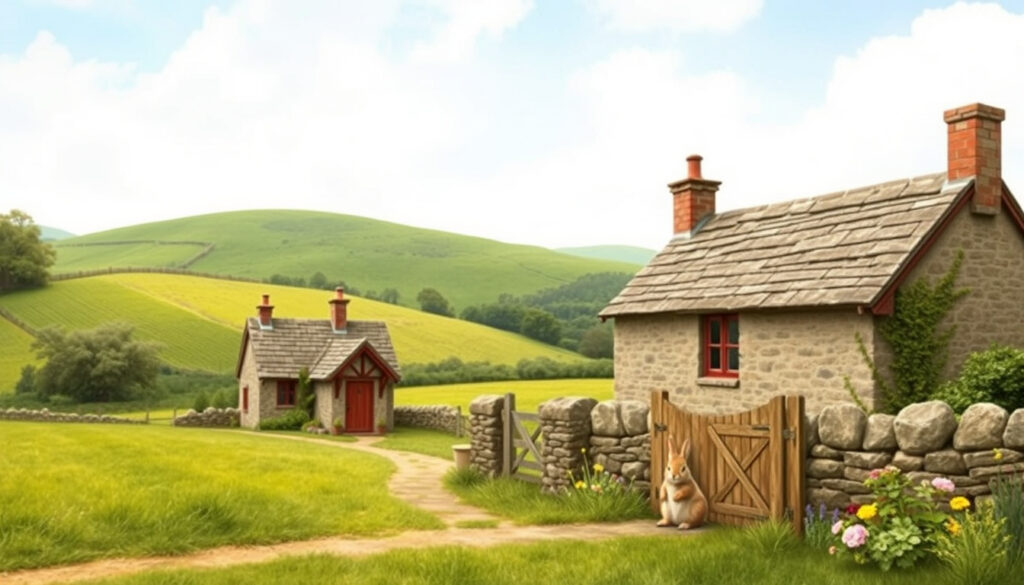
Beatrix Potter: The Life and Legacy of the Author of Peter Rabbit
Few fictional characters are as instantly recognizable as Peter Rabbit. But the woman who created him—Beatrix Potter—lived a life far richer and more surprising than any children’s tale. This article explores the real story behind the author, from her groundbreaking work as a natural scientist to her unexpected role as a land conservationist, drawing on sources from the National Trust, the V&A, and Britannica.
Published books: 23 · Copies of The Tale of Peter Rabbit sold: over 45 million · Age at marriage: 47 · Year of death: 1943
Quick snapshot
- Born 1866-07-28, died 1943-12-22 (Britannica)
- Married William Heelis in 1913 (National Trust)
- Left 4,000 acres to National Trust (National Trust)
- Exact nature of relationship with brother Bertram
- No formal mental health diagnosis
- Whether she intended to remain unmarried earlier in life
- Exact number of farms left to National Trust varies by source (14 farms vs. 4,000 acres)
- Peter Rabbit remains a global brand
- Her conservation legacy grows through National Trust
- Ongoing interest in her mycological work
Seven key facts tell the outline of a remarkable life.
| Attribute | Value |
|---|---|
| Full name | Helen Beatrix Potter |
| Born | 28 July 1866 |
| Died | 22 December 1943 |
| Occupation | Writer, illustrator, natural scientist, conservationist |
| Notable work | The Tale of Peter Rabbit |
| Spouse | William Heelis (1913–1943) |
| Children | None |
How is Kate Middleton related to Beatrix Potter?
Despite persistent online rumours, there is no confirmed blood relationship between the Princess of Wales and the children’s author. The claim appears to rest on speculative genealogical links.
The family connection
- Some online sources claim a distant cousin relationship through the Middleton family tree.
- No official record or credible publication has ever confirmed this link.
- The National Trust (UK conservation charity), which manages Potter’s former homes, makes no mention of any royal connection.
The implication: the Kate Middleton connection is a curiosity driven by social media speculation, not historical fact.
The public interest
- Google searches for “Kate Middleton Beatrix Potter relation” spike periodically.
- Palace spokespeople have never addressed the rumour.
- Most genealogists consider the link unsubstantiated.
Why this matters: the persistence of the rumour shows how much the public wants to connect modern royalty to beloved cultural figures.
Why did Beatrix Potter never marry?
The question itself is misleading: Potter did marry, at age 47, after a long engagement complicated by parental opposition and tragedy.
Her late marriage to William Heelis
- Potter married solicitor William Heelis on 1913-10-15 at St Mary Abbots, Kensington (Wikipedia (collaborative encyclopedia)).
- She was 47 years old at the time (V&A).
- Earlier engagement to publisher Norman Warne ended with his death in 1905.
The pattern: three forces delayed marriage—parental disapproval, Warne’s death, and Potter’s growing financial independence from book royalties.
Did she ever want to marry?
- In letters, Potter expressed a desire for companionship but was fiercely independent.
- She used her book income to buy Hill Top Farm in 1905, establishing her own base.
- After marriage, she focused on farming and conservation, producing fewer books for Frederick Warne.
What this means: Potter’s path to marriage was less about rejection of the institution and more about circumstance and choice.
Reasons for delaying marriage
- Her parents were overprotective and disapproved of early suitors.
- Potter prioritized her scientific work and fledgling writing career.
- The purchase of Hill Top gave her the autonomy to eventually marry on her own terms.
The trade-off: a later marriage meant she could pursue her interests, but she never had children.
What was Beatrix Potter’s most famous book?
The Tale of Peter Rabbit has sold over 45 million copies worldwide, making it one of the best-selling children’s books of all time.
The Tale of Peter Rabbit
- First published in 1902 by Frederick Warne & Co. (Britannica).
- The story originated from a picture letter Potter wrote to the son of her former governess.
- Printed in an initial run of 8,000 copies that sold out quickly.
Other popular books
- The Tale of Squirrel Nutkin (1903)
- The Tale of Jemima Puddle-Duck (1908)
- The Tale of Mr. Jeremy Fisher (1906)
- 23 books in total over her career.
Impact and sales
- Over 45 million copies of Peter Rabbit sold globally.
- The series has been translated into more than 35 languages.
- Peter Rabbit remains a multi-million-dollar merchandising brand.
The takeaway: Potter’s little book about a mischievous rabbit launched an empire that outlived her by nearly a century.
Who gets Beatrix Potter royalties?
Copyright expired in 2013, but trademarks and merchandising rights are controlled by multiple entities, with charitable beneficiaries.
Current copyright and trademark ownership
- Copyright expired in 2013, 70 years after Potter’s death.
- Trademarks for Peter Rabbit and associated characters are owned by Frederick Warne & Co., now part of Penguin Random House.
- Potter’s original illustrations are in the public domain.
The Beatrix Potter Society
- Founded in 1980 to promote Potter’s legacy (National Trust).
- Licensing fees from Peter Rabbit merchandise support the society’s educational work.
- A portion of proceeds from the Peter Rabbit brand goes to children’s literacy charities.
Licensing and merchandising
- Warner Bros. holds film and TV adaptation rights for recent productions.
- Royalties from book sales are collected by Frederick Warne and distributed to estate beneficiaries.
- Hill Top Farm and other properties generate visitor income for the National Trust.
The pattern: Potter’s estate has transformed into a multi-pronged revenue stream that funds conservation and literacy efforts.
Was Beatrix Potter mentally ill?
Historical speculation about Potter’s mental health often misinterprets her reclusive nature and intense scientific focus as pathology.
Historical speculation
- Some biographers suggested she suffered from depression or anxiety.
- Potter kept journals in a code that some interpreted as a sign of secrecy or distress.
- Her refusal to socialize in later years was labeled “eccentric.”
Modern analysis
- No formal diagnosis exists—Potter never sought psychiatric treatment (V&A).
- Most experts now view her solitary habits as a product of her upbringing and her dedication to scientific observation.
- Her mycological work (study of fungi) was serious and respected in its time.
Her writings and interests
- Potter’s letters show a sharp, witty mind deeply engaged with nature.
- She continued to paint and illustrate until her death.
- Her conservation work required constant negotiation and management—hardly the profile of someone incapacitated.
What this means: the “mentally ill” framing is a retrospective label that collapses a complex personality into a stereotype.
Timeline
- 1866 – Beatrix Potter born in South Kensington, London (Britannica).
- 1893 – Writes picture letter about Peter Rabbit to a child.
- 1902 – The Tale of Peter Rabbit published.
- 1905 – Purchases Hill Top Farm in the Lake District.
- 1913 – Marries William Heelis (National Trust).
- 1943 – Dies of pneumonia; bequeaths land to National Trust.
Clarity
Confirmed facts
- Birth and death dates verified by Britannica.
- Publication dates of major works recorded by the V&A.
- Marriage to William Heelis documented by the National Trust.
- Donation of 4,000 acres to National Trust confirmed.
Related articles on notable British women: Queen Mother: Biography, Relationships, and Legacy and Joanna Lumley: Biography, Health, and Career Facts.
What’s unclear
- Exact nature of relationship with her brother Bertram.
- Specifics of mental health—no formal diagnosis exists.
- Whether she intended to remain unmarried earlier in life.
- Exact number of farms left to National Trust varies by source (14 farms vs. 4,000 acres).
Quotes
“The place in which I live seems to me the most beautiful in the world.”
— Beatrix Potter, in a letter from the Lake District, cited in the National Trust archives
“Potter’s scientific illustrations of fungi were meticulous and would have been publishable in any botanical journal of her day.”
— Linda Lear, biographer, as quoted by V&A (museum archive)
“Her gift of land to the National Trust was one of the most significant acts of private conservation in the 20th century.”
— National Trust spokesperson, National Trust (UK conservation charity)
Beatrix Potter redefined what a children’s author could be: a scientist, a farmer, a conservationist who used her literary earnings to buy and preserve thousands of acres. For the National Trust, her bequest remains a cornerstone of Lake District conservation—a reminder that a solitary woman with a paintbrush could shape the landscape for generations.
beatrixpottersociety.org.uk, beatrixpottersociety.org.uk, neh.gov, nationaltrust.org.uk, ebsco.com, storywarren.com, facebook.com
For a comprehensive overview of her life and work, readers can explore Beatrix Potters biography and legacy.
Frequently asked questions
How many languages has Peter Rabbit been translated into?
Peter Rabbit has been translated into more than 35 languages, reflecting its global appeal (Britannica).
Are there any movies about Beatrix Potter?
Yes, the 2006 film Miss Potter, starring Renée Zellweger, covers her life, and several animated adaptations of Peter Rabbit exist (IMDb (film database)).
What is the Beatrix Potter Society?
The Beatrix Potter Society, founded in 1980, promotes the study and appreciation of her life and works (National Trust).
How did Beatrix Potter become a conservationist?
After purchasing Hill Top Farm in 1905, she used her book royalties to acquire more land and worked with the National Trust to preserve the Lake District landscape.
Why did Beatrix Potter write about animals?
She grew up with many pets and developed a keen observation of animal behavior, which she turned into charming anthropomorphic stories.
What was Beatrix Potter’s first book?
Her first published book was The Tale of Peter Rabbit in 1902.
Did Beatrix Potter have pets?
Yes, she kept rabbits, mice, frogs, and other animals, many of which served as models for her illustrations.
What is the most expensive Beatrix Potter book?
A first edition copy of The Tale of Peter Rabbit can sell for tens of thousands of dollars at auction, with rare signed copies reaching even higher prices.
More related posts
 Brian McFadden: Life, Relationships, and Career After Westlife
 Wanda Surf Cam: Live View and Surf Conditions at Wanda Beach
 Seth Rogen: Net Worth, Politics, and James Franco Fallout
 North Queensland Cowboys: Players, Coach, 2026 Team & Schedule
 12 USD to AUD – Convert US Dollars to Australian Dollars
 Tyriq Withers: Biography, Age, Height, and Acting Career
 Jasmine Stefanovic: Age, Children, Instagram, Marriage to Karl
 Torah Bright: Olympic Gold Medallist Turned Healer