Ball Pit for Toddlers: Meaning, Safety, DIY Guide (2025)
Ball pits have moved from fast-food play areas into homes and specialized centers, yet most guides treat them as a simple novelty. This Ireland-focused guide covers safety, age suitability, hygiene, and DIY options so you can decide if a ball pit works for your family.
Balls included in popular ball pit: 150 ·
Recommended age range: 1–3 years ·
IKEA ball pit introduced: 1990s ·
Hygiene recommendation: Clean balls monthly ·
Number of ball pit rooms in Ireland: 1 (Dream Point Experience)
Quick snapshot
- Ball pits exist in indoor play areas and some homes (HSE (Ireland’s health authority))
- Regular cleaning reduces bacteria (Playroom Collective (parenting safety guide))
- Ball pits are recommended for children with sensory processing needs (Sensory House (Irish sensory product seller))
- Exact bacterial load per ball in typical home setups
- Long-term safety of ball pit materials (plastic composition)
- Optimal number of balls for developmental benefit
- 1990s: IKEA introduces the first ball pit in stores
- 2000s–2010s: Ball pits become common in fast-food play areas
- 2020s: Resurgence in home ball pits due to sensory play awareness
- More research on ball pit hygiene standards expected as home use grows
- New DIY ball pit kits with sensory-friendly materials emerging
Five key facts at a glance, drawn from the latest guidance:
| Fact | Value |
|---|---|
| First ball pit introduced by IKEA | 1990s |
| Typical ball count | 150–300 |
| Recommended age | 6 months – 4 years |
| Hygiene frequency | Monthly cleaning |
| Ireland’s largest ball pit | 250,000 balls at Dream Point Experience |
The table shows that the recommended age range is wider than many parents expect, but hygiene and supervision remain the real determinants of safety.
What does ball pit mean?
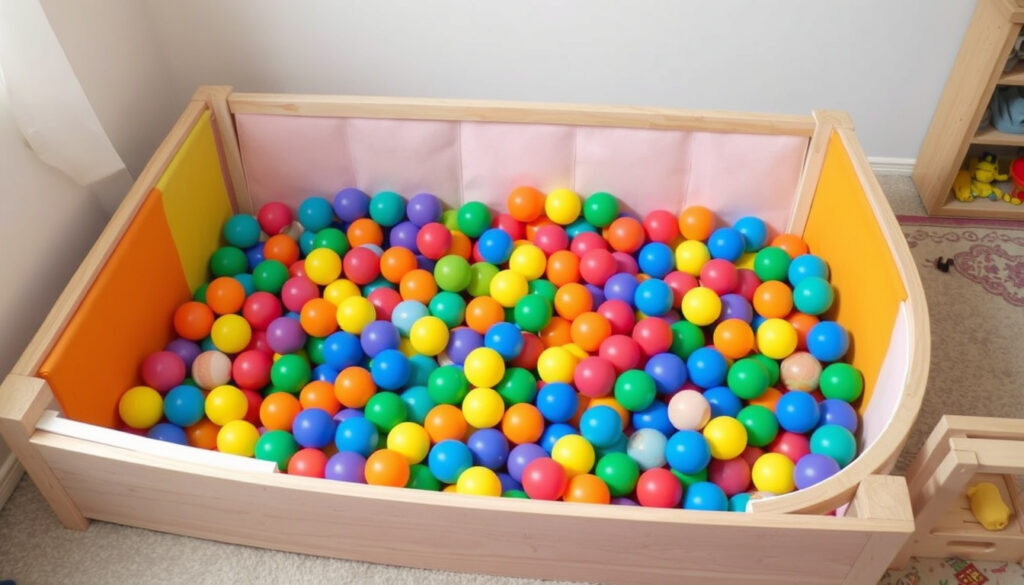
A ball pit is a defined play area filled with lightweight plastic balls, typically 7–8 cm in diameter, where children can sit, dive, and play. The concept was popularized by IKEA in the 1990s, when the Swedish furniture giant installed ball pits in its stores to keep children entertained while parents shopped (IKEA (retail history)).
Do ball pits still exist?
- Yes, ball pits are still found in indoor play centers, soft-play venues, and some fast-food restaurants, though they declined in popularity during the 2000s due to hygiene concerns.
- In Ireland, Dream Point Experience in County Meath features a ball pit with 250,000 balls, described as the country’s largest (Sensory House (Irish sensory product seller)).
- Home ball pits have seen a resurgence, driven by parents seeking sensory play tools for toddlers.
Did Ikea used to have a ball pit?
- Yes, IKEA introduced ball pits in its stores in the 1990s as part of its Småland play area. Many locations removed them during the 2010s, though some IKEA stores still offer soft-play zones.
IKEA, the retailer that introduced the ball pit to millions, now largely avoids them in its own stores — a sign of how hygiene and space concerns have reshaped the industry.
The implication: The ball pit is far from dead; it has simply moved from fast-food chains into homes and specialized play centers, where parents control the environment.
What is a good age for a ball pit?
Ball pits are typically recommended for children aged 6 months to 4 years, with supervision requirements varying by age. The U.S. Consumer Product Safety Commission (CPSC) (federal safety regulator) emphasizes that adult supervision is critical to prevent infants and toddlers from mixing with older children.
Should a 3 year old be able to catch?
- Catching ability is a developmental milestone around age 3, but it is not required for ball pit use. The Playroom Collective (parenting safety guide) notes that 18 months to 2 years is a favorable age range for ball-pit introduction, and two years old is considered an ideal age.
- Children under 9 months should avoid ball pits because of choking risks and limited ability to right themselves, according to the same guide.
Parents who introduce a ball pit too early risk frustration and safety issues; waiting until the child can sit independently and shows interest in sensory play yields better outcomes.
The pattern: Age recommendations are not one-size-fits-all. The sweet spot — 18 months to 2 years — balances developmental readiness with safety, but supervision is the non-negotiable constant.
Are ball pits safe?
Safety in ball pits comes down to three factors: supervision, hygiene, and equipment design. The HSE (Ireland’s health authority) states that children need supervision and care to stay safe when playing outdoors, a principle that applies directly to indoor ball pit play. The CPSC (U.S. federal safety regulator) adds that supervision is critical to ensure children use equipment properly and within their physical abilities.
How hygienic are ball pits?
- Ball pits can harbor bacteria if not cleaned regularly. The Playroom Collective (parenting safety guide) recommends cleaning balls monthly and disinfecting surfaces.
- According to Soft Play Market (UK soft-play equipment supplier), ball pit balls should comply with European toy safety standard EN 71, which covers chemical and physical hazards.
- Smaller balls may pose a choking hazard for younger children, while larger balls can be harder for older children to manipulate, the same source explains.
No Ireland-specific statutory ball-pit rules exist. Parents rely on general playground standards and the EN 71 certification, which places the onus on the caregiver to inspect and maintain equipment.
The trade-off: Regular cleaning takes effort, but skipping it turns a sensory tool into a bacterial reservoir. Parents who cannot commit to monthly cleaning should reconsider a home ball pit.
How do you make a ball pit?
Building a DIY ball pit is straightforward and can be done with common household items. The Sensory House (Irish sensory product seller) recommends a setup for ages 3 and older with adult supervision. Here are the steps:
- Choose a container — a playpen, inflatable pool, or cardboard box at least 16 inches high to prevent climbing out (Playroom Collective (parenting safety guide)).
- Add soft padding on the bottom — yoga mats or foam tiles work well.
- Fill with 150–300 plastic balls, each at least 7 cm in diameter for children under 3.
- Place the ball pit on a non-slip surface and keep it away from furniture corners.
- Limit play sessions to 15–20 minutes to reduce fatigue, as recommended by the Playroom Collective.
A DIY ball pit costs roughly €50–€100 for materials, compared to €150+ for commercial kits. The trade-off is time: you own the cleaning schedule and can adjust the ball count to match your child’s age.
What this means: DIY ball pits are accessible and customizable, but they require a commitment to safety checks and hygiene that commercial setups may manage for you.
Are ball pits worth it for kids?
Occupational therapists recommend ball pits for sensory play, as they provide proprioceptive and vestibular input that helps children regulate their sensory systems (Sensory House (Irish sensory product seller)). The benefits include improved gross motor skills, social play opportunities, and independent play.
Upsides
- Encourages sensory stimulation and motor development
- Promotes independent play for short periods
- Can be used indoors year-round
- Easy to customize with themed balls or lights
Downsides
- Requires regular cleaning and storage space
- Plastic balls may degrade over time
- Not suitable for children under 6 months
- Can become a tripping hazard in small rooms
The pattern: Ball pits are a strong investment for families with toddlers who enjoy sensory play, but they lose value quickly if the child outgrows them or if cleaning becomes a burden. For Irish parents, the Dream Point Experience offers a low-commitment alternative to test the waters before buying.
Timeline
The evolution of ball pits from novelty to sensory staple:
- 1990s: IKEA introduces the first ball pit in its stores (IKEA (retail history)).
- 2000s–2010s: Ball pits become common in fast-food play areas and indoor play centers, then decline due to hygiene concerns.
- 2020s: Resurgence in home ball pits driven by sensory play awareness and DIY trends.
Clarity section
Confirmed facts
- Ball pits exist in indoor play areas and some homes.
- Regular cleaning reduces bacteria.
- Ball pits are recommended for children with sensory processing needs.
What remains unclear
- Exact bacterial load per ball in typical home setups.
- Long-term safety of ball pit materials (plastic composition).
- Optimal number of balls for developmental benefit.
- Whether EN 71 certification alone guarantees safety in all ball pit balls.
Expert perspectives
“Ball pits provide proprioceptive and vestibular input, helping children regulate their sensory systems.”
— Occupational therapist, Children’s Therapy Center (cited by Sensory House (Irish sensory product seller))
“Children need supervision and care to stay safe when playing outdoors.”
“Supervision is critical to ensure children use equipment properly and within their physical abilities.”
— U.S. Consumer Product Safety Commission (federal safety regulator)
Summary
Ball pits have evolved from a 1990s retail gimmick into a legitimate tool for child development, backed by occupational therapists and rediscovered by parents who value sensory play. The key is informed use: choose the right age window, maintain hygiene, and supervise closely. For Irish families, the choice is clear: invest in a DIY ball pit and commit to monthly cleaning, or visit a dedicated play center like Dream Point Experience to test the benefits without the upkeep.
The implication: Irish parents who skip regular cleaning turn a developmental tool into a hygiene risk, while those who maintain the routine gain a proven sensory aid.
troomi.com, anthonycollins.com, bubsnbits.com.au, sosoftplay.co.uk, cheereurope.com, blog.sensoryedge.com, greentreeplay.ie
For a deeper dive into age recommendations and construction details, see this expert-backed ball pit guide for toddlers.
Frequently asked questions
Do ball pits help with sensory development?
Yes, occupational therapists recommend ball pits for sensory play because they provide proprioceptive and vestibular input, helping children regulate their sensory systems (Sensory House (Irish sensory product seller)).
How many balls do I need for a ball pit?
Typical home ball pits use 150–300 balls, depending on the size of the container. The Playroom Collective (parenting safety guide) recommends enough balls to cover the floor to a depth of about 8–10 inches.
Can adults use ball pits?
Yes, adult ball pits exist in some recreational centers and sensory rooms, but they are designed for heavier use. Home ball pits intended for toddlers are not structurally suitable for adults.
Are ball pits safe for babies under 6 months?
No. The Playroom Collective (parenting safety guide) advises that children under 9 months should avoid ball pits because of choking risks and limited ability to right themselves.
What is the best material for ball pit balls?
Balls should be made of low-density polyethylene (LDPE) that complies with EN 71 standards. The Soft Play Market (UK soft-play equipment supplier) recommends balls at least 7 cm in diameter for children under 3.
How to clean ball pit balls effectively?
The Playroom Collective (parenting safety guide) recommends wiping balls with a mild soap solution monthly and disinfecting the container. For deep cleaning, place balls in a mesh bag and run through a gentle dishwasher cycle.
What is the difference between a ball pit and a ball pond?
Both terms are used interchangeably, but “ball pond” is sometimes used in the UK and Ireland to describe larger, deeper ball pits often found in commercial play centers. There is no technical difference.
More related posts
 Michael Carrick: Manchester United Head Coach Updates
 Kareem Abdul-Jabbar: Biography, Stats, Net Worth, and More
 Who Won the Election: Ireland 2025 Presidential Results
 Clementine Ford Writer: Instagram Exit and What’s Next
 Matty Johns: Age, Net Worth, Career, and Andrew Johns
 Raiders vs Dragons 2026: Head-to-Head & Match Preview
 Kevin Bloody Wilson: Biography, Songs and 2024 Tour Dates
 Criminal Minds Reid: What Happened & Return Status 2025