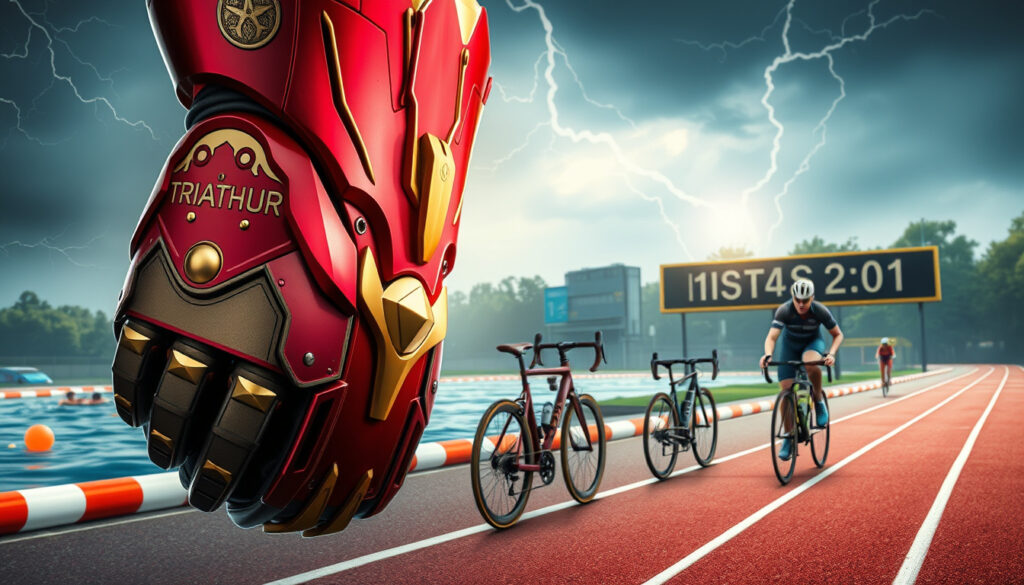
Iron Man vs Ironman: Race Distance & Marvel Origin
Few names carry two completely different meanings the way “Iron Man” does: for some, it’s a 226.3-kilometer triathlon; for others, it’s the billionaire inventor in a red-and-gold suit. This article separates the two using official race data and comic canon so you can finally tell which is which.
Ironman triathlon total distance: 226.3 km (140.6 miles) ·
Ironman swim leg distance: 3.86 km (2.4 miles) ·
Ironman bike leg distance: 180.25 km (112 miles) ·
Ironman run leg distance: 42.2 km (26.2 miles) ·
Average Ironman finish time: 12 to 17 hours ·
Ironman event founded: 1978 in Hawaii
Quick snapshot
- Full Ironman triathlon distance: 226.3 km (IRONMAN official site (governing body))
- Marvel’s Iron Man first appeared in 1963 (Wikipedia – Marvel character page (reference source))
- Ironman race cut-off is 17 hours (IRONMAN event rules (race organizer))
- World Championship held in Kona, Hawaii (IRONMAN history page (brand archive))
- Exact number of global Ironman events in 2024 varies year-to-year (IRONMAN event calendar (race organizer))
- Whether age 40 is “too old” depends on individual fitness, not a rule (BetterTriathlete analysis (training community))
- 1963 – First Iron Man comic (Wikipedia – Marvel character page (reference source))
- 1978 – First Ironman triathlon in Hawaii (IRONMAN history page (brand archive))
- 2008 – Iron Man film launches MCU (Wikipedia – Iron Man film (reference source))
- 2019 – Ironman global series expands to 40+ races (IRONMAN event calendar (race organizer))
- Ironman 2024 season includes new races in Asia and Europe (IRONMAN event calendar (race organizer))
- Marvel Studios continues Iron Man legacy through Avengers spinoffs (Wikipedia – Iron Man film (reference source))
| Specification | Value |
|---|---|
| Total distance | 226.3 km (140.6 miles) |
| Swim distance | 3.86 km (2.4 miles) |
| Bike distance | 180.25 km (112 miles) |
| Run distance | 42.2 km (26.2 miles) |
| Average finish time | 12 to 17 hours |
| Event founded | 1978 in Hawaii |
What is a full Iron Man triathlon?
A full Ironman triathlon is the single-day endurance event that combines three disciplines into one continuous race. The official distance, set by the World Triathlon Corporation, totals 226.3 km (140.6 miles) — a swim, a bike, and a run that push athletes to their physical and mental limits.
Distance breakdown: swim, bike, run
The full distance is split into three legs:
- Swim: 3.86 km (2.4 miles) in open water
- Bike: 180.25 km (112 miles) on a road course
- Run: 42.2 km (26.2 miles) — a full marathon
Those numbers come directly from the IRONMAN official site (governing body). The World Championship course in Kona, Hawaii, follows the same distances, but the terrain — lava fields, ocean currents, and heat — makes it a different beast altogether.
Why it is called the “full” Ironman
The term “full Ironman” distinguishes this distance from shorter triathlon formats. The half Ironman, officially called IRONMAN 70.3, totals 70.3 miles (113 km). The Olympic distance is even shorter at 51.5 km total. According to Triathlete magazine (specialist triathlon media), the “Iron-distance” is the standard for the extreme endurance challenge.
Half Ironman vs. full Ironman comparison
One pattern, two distances: the half is exactly half of the full. The full requires roughly double the training time and recovery.
| Metric | Half Ironman (70.3) | Full Ironman (140.6) |
|---|---|---|
| Swim | 1.9 km (1.2 mi) | 3.86 km (2.4 mi) |
| Bike | 90 km (56 mi) | 180.25 km (112 mi) |
| Run | 21.1 km (13.1 mi) | 42.2 km (26.2 mi) |
| Total distance | 113 km (70.3 mi) | 226.3 km (140.6 mi) |
| Typical finish time | 5–8 hours | 12–17 hours |
The implication: the half is a serious endurance test, but the full is in a different league of physical demand and time commitment.
A typical athlete burns 8,000–10,000 calories during a full Ironman. Most amateur finishers lose 2–4% of body weight through sweat and effort, making hydration and nutrition as critical as the training itself.
How many kilometers is the Ironman race?
The total distance is 226.3 km, but the exact kilometer breakdown varies slightly depending on rounding. The IRONMAN official site (governing body) states the swim is 3.86 km, the bike 180.25 km, and the run 42.2 km. Some sources round the swim to 3.9 km and the bike to 180 km, as noted by Supertri (elite racing platform).
Exact distances for each leg
- Swim: 3.86 km (2.4 miles)
- Bike: 180.25 km (112 miles)
- Run: 42.2 km (26.2 miles)
These precise figures are used by the World Triathlon Corporation for all IRONMAN-branded full-distance events.
How the metric system is used globally
Most Ironman events outside the United States report distances in kilometers. The race includes the full marathon distance for the run, which is 42.2 km. According to Tri247 (triathlon training resource), the marathon leg is deliberately chosen to test runners who have already completed the swim and bike.
Historical race distance origin
The original 1978 Ironman combined existing events on Oahu: the Waikiki Roughwater Swim (2.4 miles), the Around-Oahu Bike Race (112 miles), and the Honolulu Marathon (26.2 miles). The IRONMAN history page (brand archive) confirms that the founders aimed to create a single event that would test the limits of human endurance.
The pattern: the distances were inherited from pre-existing races, not invented for the Ironman. That’s why the bike leg is 112 miles — not a round number in kilometers.
How long does it take to finish an Ironman?
Most amateur finishers cross the line between 12 and 17 hours. Professional athletes complete the course in under 9 hours. The cutoff for all participants is 17 hours from the start, enforced by the IRONMAN event rules (race organizer).
Average finish times by age group
Finish times vary widely by age, gender, and experience. Data from BodySpec (athlete analytics platform) shows that male athletes aged 30–34 average about 12:30, while female athletes in the same age group average 13:45. Times increase gradually after age 50.
Factors that affect finish time
- Course difficulty (flat vs. hilly, hot vs. temperate)
- Swim conditions (currents, waves, water temperature)
- Nutrition and pacing strategy
- Previous endurance experience
According to BetterTriathlete (training community), the bike leg is where most time is made or lost, accounting for roughly 45% of total race time.
Cut-off time of 17 hours
The 17-hour cut-off is strict. The swim must be completed within 2 hours 20 minutes. After that, the bike leg has a cut-off of roughly 10.5 hours from the start, and the run must be finished by midnight. These limits are set by the IRONMAN event rules (race organizer) to ensure safety and road closure logistics.
Why this matters: the cut-off is not just a deadline — it’s the defining constraint of the event. Many aspirants fail on the swim cutoff, which is why open-water training is essential.
Why is it called an Ironman?
The name “Ironman” was coined by race co-founder John Collins during the award ceremony of the first event in 1978. He said, “Whoever finishes first, we’ll call him the Iron Man.” The IRONMAN history page (brand archive) records this origin, linking the name to the idea of an unbreakable will.
Origin of the name from the 1978 race
John Collins, a U.S. Navy officer, and his wife Judy Collins organized the first race after a debate about which sport was more demanding: swimming, cycling, or running. The solution was to combine all three. The term “Ironman” was a spontaneous label, not a marketing concept.
Connection to the term “iron will”
The name evokes the mental toughness required to finish. As Triathlete magazine (specialist triathlon media) notes, the term has become synonymous with extreme endurance, representing a “feat of iron will” as much as physical strength.
Official trademark by World Triathlon Corporation
Today, “IRONMAN” is a registered trademark of the World Triathlon Corporation. The IRONMAN official site (governing body) licenses the brand to events worldwide. Non-branded races of the same distance often use the term “Iron-distance” to avoid trademark issues.
“Swim 2.4 miles, bike 112 miles, run 26.2 miles, and then have a beer.”
— John Collins, co-founder of the Ironman, as recalled in IRONMAN history page (brand archive)
The trade-off: the brand now owns the term, but the original spirit of the event remains in the distance itself.
Who was the original Iron Man?
In the Marvel Universe, the original Iron Man is Tony Stark, a billionaire industrialist and genius inventor. The character first appeared in 1963 in Tales of Suspense #39, created by Stan Lee, Larry Lieber, Don Heck, and Jack Kirby. According to Wikipedia – Marvel character page (reference source), Stark built the powered armor suit to escape captivity and later became a founding member of the Avengers.
Tony Stark as the original Marvel superhero
Stark’s alter ego is a self-made billionaire whose suit of armor grants him superhuman strength, flight, and an array of weapons. Unlike the triathlon’s “Ironman,” the superhero is a fictional character with a distinct origin story and a long-running comic series.
First appearance in Tales of Suspense #39
The issue, dated March 1963, introduced Tony Stark as a weapons manufacturer who is injured and taken prisoner. He builds the first Iron Man suit to escape. The creation is credited to writer Stan Lee, plotter Larry Lieber, penciler Don Heck, and cover artist Jack Kirby.
Real-world inspiration: Howard Hughes
Stan Lee later said he modeled Tony Stark’s playboy-industrialist persona on Howard Hughes, the eccentric inventor and aviator. This detail is confirmed by Wikipedia – Marvel character page (reference source).
“I thought it would be fun to take a character who was a villain and make him a hero.”
— Stan Lee, reflecting on the creation of Iron Man, as recounted in Wikipedia – Marvel character page (reference source)
The pattern: the superhero’s origin is a Cold War-era story of redemption and technology, while the triathlon’s origin is a real-world test of endurance. Both share the “Iron” moniker, but little else.
Is 40 too old for an Ironman?
No. Age groups in Ironman races go up to 80+. The IRONMAN event rules (race organizer) categorize athletes by 5-year increments, with the oldest group being 80+. Many athletes start their Ironman journey after 40, and world records exist for every age group.
Age group categories for Ironman races
Typical age groups: 18–24, 25–29, 30–34, 35–39, 40–44, 45–49, 50–54, 55–59, 60–64, 65–69, 70–74, 75–79, 80+. The 40–44 age group is often one of the largest in terms of participation.
Success stories of athletes over 40
Numerous athletes have completed Ironman races after 40, including first-timers. According to BetterTriathlete (training community), the 40–49 age group often has the highest number of finishers, reflecting the demographic’s disposable income and life experience.
Training adaptations for older participants
Older athletes may need longer recovery, more careful nutrition, and adjusted training volumes. However, the event itself does not discriminate. The cut-off of 17 hours is generous enough for most fit individuals, regardless of age.
The real barrier is not age but time commitment. A 40-year-old with a full-time job and family will need to carve out 10–20 hours per week for training. For many, that’s the harder challenge.
The pattern: age is less of a barrier than the time commitment required for training.
Who is the true Iron Man?
In Marvel canon, Tony Stark is the definitive Iron Man. While other characters have taken the mantle in alternate universes (e.g., Ironheart, Riri Williams; or different versions of Stark), the primary continuity — Earth-616 — recognizes Tony Stark as the original. The Wikipedia – Marvel character page (reference source) confirms that Stark is the central figure.
Marvel canon: Tony Stark as the definitive Iron Man
Stark’s story spans decades of comics, animated series, and the Marvel Cinematic Universe (MCU). The 2008 film Iron Man, starring Robert Downey Jr., launched the MCU and cemented Stark as a pop culture icon.
Other characters who took the mantle
In the comics, other characters have briefly worn the Iron Man armor, including James Rhodes (War Machine) and Riri Williams (Ironheart). But Tony Stark remains the original and the one most associated with the name.
Distinction from Ironman (sport)
The triathlon’s “Ironman” and the superhero’s “Iron Man” are spelled the same in lowercase but capitalized differently. The triathlon is one word; the superhero is two. This is a minor but consistent distinction used by the IRONMAN official site (governing body) and Marvel’s publications.
The implication: if someone says “Iron Man” with a capital M, they likely mean the superhero. If they say “Ironman” as one word, they mean the race. The search confusion is real, and the semantic difference matters.
Upsides
- Completing a full Ironman is a life-changing achievement
- Builds discipline, fitness, and mental toughness
- Strong community support and global events
- Age is not a barrier — many start after 40
Downsides
- Extremely time-consuming: 10–20 hours/week training for 6–12 months
- High risk of injury, overtraining, and burnout
- Expensive: gear, race fees, travel can exceed $5,000
- Cut-off times can be stressful for slower athletes
Timeline: Ironman and Iron Man history
Four key dates tell the story of both “Iron Man” meanings.
- 1963 – First Iron Man comic published by Marvel (Tales of Suspense #39)
- 1978 – First Ironman triathlon held in Hawaii; 15 participants, 12 finishers
- 2008 – Marvel’s Iron Man film released, launching the MCU
- 2019 – Ironman global series expands to 40+ events in 20+ countries
These milestones are documented by IRONMAN history page (brand archive) and Wikipedia – Marvel character page (reference source).
en.wikipedia.org, the5krunner.com, en.wikipedia.org, pl.wikipedia.org, fr.wikipedia.org
Frequently asked questions
What is an Ironman triathlon?
An Ironman triathlon is a long-distance race consisting of a 3.86 km swim, 180.25 km bike, and 42.2 km run — totaling 226.3 km. It is the most famous full-distance triathlon format, governed by the World Triathlon Corporation.
How long is an Ironman race?
The full distance is 226.3 km (140.6 miles). The swim is 3.86 km, the bike is 180.25 km, and the run is a full marathon of 42.2 km.
Can a 40-year-old do an Ironman?
Yes. Age groups go up to 80+, and many first-time Ironman athletes are over 40. The key is proper training, nutrition, and time commitment.
What is the cutoff time for an Ironman?
The overall cutoff is 17 hours. The swim must be completed in 2 hours 20 minutes, and the bike must be finished by approximately 10.5 hours from the start.
How do I train for my first Ironman?
Most training plans span 6–12 months, with 10–20 hours of weekly training across swimming, cycling, and running. Joining a local triathlon club and hiring a coach can help. Start with shorter distances like a sprint or half Ironman.
For anyone searching “Iron Man,” the answer is both a race and a superhero. The triathlon demands 226.3 km of endurance; the comic book character offers a fictional journey of genius and redemption. If you’re considering an Ironman, the challenge is real — but so is the reward. For the fan of Marvel’s Iron Man, the story lives on in comics and the MCU. The choice is clear: know which one you’re looking for, and you’ll never be confused again.
More related posts
 Margot Robbie Barbie: Salary, Casting & Controversies
 Sinead O’Connor: Cause of Death, Controversy, Children, Religion
 Berberine at Chemist Warehouse: Weight Loss & Safety Guide
 UploadBlog Document Upload on Blogger: Google Drive Guide
 The Hateful Eight – Plot, Cast, Awards and Secrets
 Vending Machine for Sale in Ireland: Prices, Licenses & Locations
 Xavier Savage Injury Update: Heritage, Salary and Stats
 Tax Thresholds 2025 – UK Income Tax Bands and NI Rates