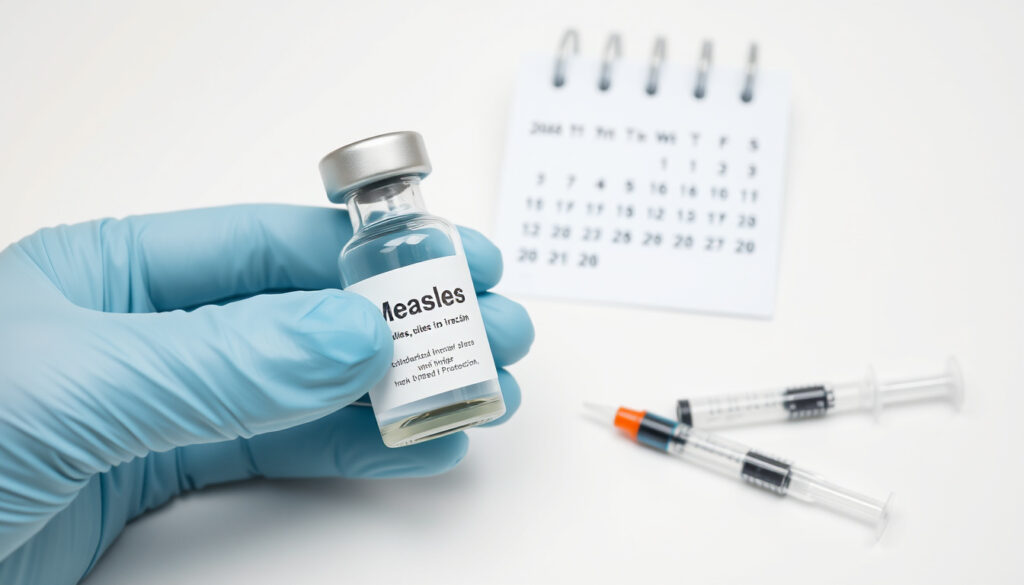
Measles Vaccine: Who Needs a Booster in 2026
Few things spark as much confusion among adults as the question of whether they’re still protected against measles after childhood vaccination. With outbreaks making headlines in 2026, many are wondering if their immunity has faded and whether they need a booster.
MMR vaccine doses recommended: 2 doses ·
First dose age: 12–15 months ·
Second dose age: 4–6 years ·
Effectiveness after two doses: 97% (CDC) ·
Protection duration: Lifelong for most
Quick snapshot
- Whether a universal adult booster will be recommended in 2026
- How long immunity lasts for every individual
- Exact waning rate in older adults
- CDC updates booster guidance during outbreaks (CDC)
- WHO adjusts schedule for high-incidence regions (WHO)
- 2026 booster recommendations for high-risk adults
- Possible updated guidance from ACIP
Five key facts, one pattern: the measles vaccine story is not one-size-fits-all. Birth year, exposure risk, and travel plans all change the answer.
The pattern: Your personal risk profile — not a universal rule — decides whether you need that extra shot.
| Fact | Value |
|---|---|
| Recommended doses | 2 doses of MMR |
| First dose age | 12–15 months |
| Second dose age | 4–6 years |
| Effectiveness after two doses | 97% (CDC) |
| Booster needed for | High-risk adults (healthcare, travel, outbreaks) |
Should I get a measles booster in 2026?
If you’re an adult with two documented doses of MMR given after age 12 months, you don’t need a routine booster — but specific risk groups do.
Do adults need a measles booster?
According to the CDC (U.S. public health agency), most adults born during or after 1957 need at least one dose of measles vaccine to be considered protected. People who received two doses as children are considered protected for life. However, certain groups may require a second dose if they only had one. These include CDC (U.S. public health agency):
- Students at post-high school educational institutions
- Healthcare personnel
- Household contacts of immunocompromised people
- Adults living with HIV who are not severely immunocompromised
- People deemed at increased risk during an outbreak
Can older adults get measles again?
While the MMR vaccine provides long-lasting protection for most, immunity can wane over time — especially in older adults. The CDC (U.S. public health agency) notes that breakthrough infections are rare but possible. For those unsure of their vaccine history, a blood test can check immunity.
What factors determine if a booster is needed?
Your risk depends on your age, occupation, travel plans, and local outbreak activity. The CDC (U.S. public health agency) recommends that adults without evidence of immunity receive at least one dose of MMR. If you work in healthcare or plan to travel internationally, a second dose may be advised.
Editor’s note: This section reflects 2024-2025 CDC guidance. ACIP may update recommendations in 2026.
The implication: Your personal risk profile — not a universal rule — decides whether you need that extra shot.
Does a measles vaccine last for life?
Can I get the measles if I’ve already been vaccinated?
Breakthrough infections are rare. The CDC (U.S. public health agency) states that two doses are 97% effective, while one dose is 93% effective. When breakthrough cases occur, they are typically mild. Still, some research suggests that immunity may decline slowly in older adults — though the exact rate remains unclear.
How effective is the vaccine after two doses?
The CDC (U.S. public health agency) reports that two doses provide protection for nearly everyone who receives them. The Immunize.org (vaccine education resource) explains that the second dose is not a booster — it’s designed to catch the small percentage of people who didn’t respond to the first dose.
Why might immunity wane?
No vaccine is 100% effective forever. The CDC (U.S. public health agency) says that people with two documented doses given on schedule “should be protected for life.” Yet some older adults lose protection as their immune system ages. This is one reason the question of a universal adult booster continues to be studied.
For the vast majority, two doses equal lifetime protection. For a small minority — especially those with waning immunity — a booster may be prudent during an outbreak.
Why this matters: The rare breakthrough case reminds us that population-level protection (herd immunity) depends on high vaccination rates.
At what age is the measles vaccine given?
Why can’t babies under 12 months get the measles vaccine?
Infants under 12 months may still have maternal antibodies that can interfere with the vaccine’s effectiveness. The CDC (U.S. public health agency) recommends that infants aged 6–11 months get one dose before international travel, followed by two more doses after their first birthday.
What is the recommended schedule for the measles vaccine?
- First dose at 12–15 months (CDC)
- Second dose at 4–6 years (CDC)
- Minimum interval between doses: 28 days (American Academy of Pediatrics)
In the UK, the NHS (U.K. health authority) gives the first dose at 12 months and the second at 18 months. In high-risk countries, the WHO (global health organization) recommends the first dose at 9 months.
Is there a difference for international travel?
Yes. The CDC (U.S. public health agency) advises that travelers receive two doses at least 28 days apart before departing. Infants 6–11 months should get one early dose and then complete the routine schedule after age 1.
The pattern: The schedule adjusts based on risk — early for high-exposure, standard for routine, and catch-up for anyone who missed a dose.
Are measles vaccine and MMR vaccine the same?
What does MMR stand for?
MMR stands for measles, mumps, and rubella. The CDC (U.S. public health agency) uses the combined MMR vaccine exclusively. No separate measles-only vaccine is available in most countries.
Are there separate vaccines for measles?
Not in routine use. The Immunize.org (vaccine education resource) confirms that MMR is as safe and effective as the individual components. Some countries may offer a monovalent measles vaccine in special circumstances, but it is rare.
The catch: When you hear “measles vaccine,” it almost always means the MMR shot.
Why are people refusing the MMR vaccine?
What are the common reasons for vaccine hesitancy?
- A discredited 1998 study linking MMR to autism (CDC)
- Religious or philosophical exemptions
- Misinformation spread on social media
- Fear of side effects
The CDC (U.S. public health agency) and WHO (global health organization) have repeatedly stated that extensive studies confirm no link between MMR and autism.
Is the MMR vaccine safe?
Yes. The CDC (U.S. public health agency) emphasizes that MMR has a well-established safety record. Side effects are generally mild (fever, rash) and serious adverse events are extremely rare. The NHS (U.K. health authority) recommends the vaccine as safe and effective for all eligible children.
Hesitancy is driven by persistent myths, not evidence. Public health campaigns need to address emotional concerns, not just cite statistics.
Why this matters: Declining vaccination rates have led to measles outbreaks in communities with low MMR coverage.
Upsides
- Highly effective (97% after two doses)
- Long-lasting protection for most
- Prevents serious complications like pneumonia and encephalitis
- Safe with decades of use
Downsides
- Mild side effects (fever, rash) in some recipients
- Rare allergic reactions
- Waning immunity in a small number of older adults
- Vaccine hesitancy reduces community coverage
Two doses of MMR vaccine are about 97% effective at preventing measles.
CDC (U.S. public health agency)
WHO recommends vaccination at 9 months in high-risk areas and at 12–15 months elsewhere.
WHO (global health organization)
For the average adult in 2026, the decision is clear: check your vaccination record. If you have two documented doses, you’re protected. If you’re unsure, get a titer test or a dose. The only wrong move is not knowing.
cdc.gov, healthclinics.superdrug.com, axios.com, pmc.ncbi.nlm.nih.gov, notts.icb.nhs.uk, ccjm.org, hopkinsguides.com
Frequently asked questions
What is the MMR vaccine?
The MMR vaccine protects against measles, mumps, and rubella. It is a single shot given in two doses as part of routine childhood immunization (CDC).
Is the measles vaccine required for school?
Yes, in most U.S. states, children must have proof of MMR vaccination to attend school. Exemptions exist for medical and some non-medical reasons (CDC).
Can the measles vaccine cause side effects?
Side effects are usually mild and include fever, rash, and soreness at the injection site. Serious side effects are extremely rare (CDC).
How does the measles vaccine work?
It contains a weakened live virus that triggers your immune system to produce antibodies without causing the disease. This provides long-term protection (CDC).
What should I do if I missed a dose?
You can catch up at any age. The CDC recommends one or two doses depending on your risk factors. Talk to your healthcare provider (CDC).
Is it safe to get the MMR vaccine during pregnancy?
No. MMR is a live vaccine and should not be given during pregnancy. Women should avoid pregnancy for 4 weeks after vaccination (CDC).
Can adults get the measles vaccine if they never had it as a child?
Yes. Adults without evidence of immunity should receive at least one dose of MMR. Those at high risk may need two doses (CDC).
More related posts
 Jimmy Rees: From Giggle and Hoot to Comedy Star
 Nashville vs Inter Miami: Rivalry, Results, Messi’s Impact
 Katherine Bennell-Pegg: Biography, Education, Husband & Facts
 Karen Read Case: Verdicts, Theories, and Family Reactions
 Curtis Sliwa: Net Worth, Height, Wife, and Political Career
 Camila Morrone: Age, Career, Relationship with DiCaprio & Facts
 What Is the Date Today – Today’s Date in Your Timezone
 Westpac Branch Near Me: Find Locations, Hours & ATMs