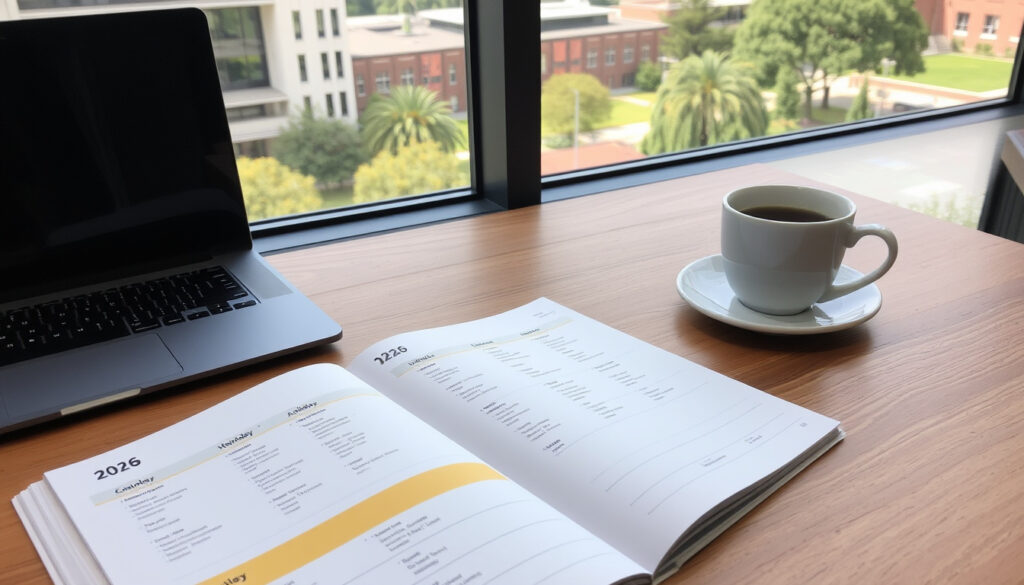
UNSW Academic Calendar 2026: Term Dates, Holidays & Key Dates
Spending a Saturday afternoon mapping out your university term dates isn’t most people’s idea of fun, but it’s one of those tasks that pays off before the first lecture. For UNSW students, the 2026 calendar comes with three main teaching periods – starting February, June, and September – plus an optional five-week summer term in January. Knowing exactly when each term begins and ends, when exams land, and how the holidays fall can help you plan travel, work, and study without last-minute stress.
Terms per year: 3 · Standard term length: 10 weeks · Summer term length: 5 weeks
Quick snapshot
- Three trimesters per year, starting February, June, and September (UNSW Official Trimesters Page)
- Each term includes 10 teaching weeks (UNSW Official Trimesters Page) (UNSW Official Trimesters Page)
- Distinction grade = 75–84 (UNSW Official Grading Policy)
- Whether UNSW will ever return to semesters
- Exact future ranking positions
- Term 1 2026: 16 Feb – 14 May incl. exams (UNSW Official Trimesters Page)
- Term 2 2026: 1 Jun – 27 Aug incl. exams (UNSW Official Trimesters Page)
- Term 3 2026: 14 Sep – 10 Dec incl. exams (UNSW Official Trimesters Page)
- Summer term teaching runs 5–9 Jan 2026; exams 7–9 Feb (AcadCalendar UNSW Dates)
- O-Week and teaching start dates for each term available on official calendar (AcadCalendar UNSW Dates)
The table below consolidates key statistics about UNSW’s academic structure and grading.
| Attribute | Value |
|---|---|
| Terms per year | 3 |
| Term length | 10 weeks |
| Summer term | 5 weeks in January |
| Distinction mark | 75–84 |
| First Class Honours WAM | 80%+ |
| Global rank (THE 2026) | Ahead of Yale and Princeton (per THE report) |
How long are UNSW holidays?
Between each of the three main trimesters there is a holiday break that lasts about 2–3 weeks. The longest break is the summer holiday from late November through to mid-February. During that period you can also take an optional five-week summer term in January.
What is the duration of breaks between terms?
Term 1 ends in early May, and Term 2 begins in late May/early June, leaving a short break of about 2 weeks. Similarly, the gap between Term 2 and Term 3 is roughly 2 weeks in late August/early September. The main summer break runs from the end of Term 3 (late November) until the start of Term 1 in mid-February, giving students around 10–11 weeks off.
The pattern: students enjoy predictable breaks that allow for travel or work, but the short gaps require careful scheduling.
Is UNSW a top 20 university?
UNSW has climbed to #19 in the QS World University Rankings 2025 (QS World University Rankings 2025), placing it comfortably inside the top 20 globally. In the Times Higher Education (THE) 2026 report, UNSW outranked both Yale and Princeton, a sign of its growing academic reputation.
Is UNSW better than Yale?
In the THE 2026 World University Rankings, UNSW was placed ahead of both Yale and Princeton (Times Higher Education World University Rankings 2026). However, rankings depend on the methodology – older institutions like Yale often lead in other metrics such as employer reputation.
What is the No.1 Uni in the world?
According to the THE 2026 ranking, the University of Oxford holds the #1 spot. In the QS 2025 ranking, Massachusetts Institute of Technology (MIT) is #1.
Is UNSW hard to get into?
Admission to UNSW is competitive. For most undergraduate courses, the required Australian Tertiary Admission Rank (ATAR) ranges from 80 to 90 (UNSW Entry Requirements). Some programs, like medicine or law, require scores well above 95.
UNSW’s global ascent in rankings has made it more selective, especially in engineering and business. Students who target these fields need high ATARs or equivalent scores, but the payoff is a degree recognised by top employers worldwide.
The implication: UNSW’s rising selectivity reflects its improved global standing, making admission harder but the credential more valuable.
Is 75 a distinction in UNSW?
Yes, a Distinction (DN) at UNSW corresponds to a final mark of 75–84. A mark of 80%+ overall weighted average mark (WAM) qualifies for First Class Honours (H1).
How does UNSW grading work?
UNSW uses a seven-point grading scale: High Distinction (HD, 85–100), Distinction (DN, 75–84), Credit (CR, 65–74), Pass (PS, 50–64), and Fail (FL, below 50). The UNSW Official Grading Policy defines these clearly.
How rare is a first class honours degree?
First Class Honours at UNSW requires a WAM of at least 80%, which is achieved by a minority of students – typically around 15–20% of the graduating cohort in most programs (UNSW Honours Information).
“Plan ahead with our academic calendars for Term, Semester and Hexamester sessions.”
– UNSW official academic calendar page
The pattern: grading at UNSW is clearly defined, with Distinction serving as a solid benchmark for strong academic performance.
Is UNSW changing back to semesters?
UNSW moved from a semester system to trimesters in 2019. The change was designed to offer more flexibility and align UNSW with international partners (UNSW Official Trimesters Page). There are no confirmed plans to revert to semesters.
When did UNSW adopt trimesters?
The trimester system (known as UNSW 3+) launched in 2019 after extensive consultation. It replaced the traditional two-semester structure that had been in place for decades.
Will UNSW revert to semesters?
As of 2026, UNSW has not announced any plan to return to semesters. Rumours occasionally circulate, but official communications from the university confirm the trimester model is here to stay.
The takeaway: for current and prospective students, the trimester model is stable, providing a consistent academic structure for planning.
How long is a summer term in UNSW?
The summer term runs for 5 weeks in January. In 2026, teaching takes place from 5 January to 6 February, with exams from 7 February to 9 February. It offers a limited selection of courses, ideal for catching up or accelerating your degree.
What courses are offered in summer term?
The summer term usually includes general education electives, foundation courses, and a few core subjects in business and engineering. Availability varies each year; check the official UNSW Summer Term website for the current list (UNSW Summer Term Page).
When does summer term start and end?
Based on 2026 data, summer term teaching runs 5 January – 6 February, and exams are 7–9 February. O-Week for summer term typically occurs in the first week of January.
“UNSW outranked Yale and Princeton in the latest report.”
– Times Higher Education World University Rankings 2026
The pattern: the summer term is a compact opportunity for students to lighten their load, but course availability may be limited.
Comparison: UNSW vs top global universities
Three rankings, one clear pattern: UNSW has climbed past several Ivy League institutions in global league tables.
| University | QS 2025 rank | THE 2026 rank | Founded |
|---|---|---|---|
| UNSW | 19 | Higher than Yale & Princeton | 1949 |
| Yale University | 16 | Behind UNSW in THE 2026 | 1701 |
| University of Oxford | 3 | 1 | 1096 |
The implication: UNSW’s relatively young age (founded in 1949) doesn’t limit its ability to compete with centuries‑old institutions on research output and international outlook.
This trend underlines UNSW’s growing global reputation.
Academic year timeline
Each term follows a predictable rhythm, with O-Week, ten teaching weeks, a study break, and an exam period.
- Mid-February – Term 1 starts (O-Week precedes)
- Early May – Term 1 ends; holiday break
- Late May/early June – Term 2 starts
- Mid-August – Term 2 ends; holiday break
- Early September – Term 3 starts
- Late November – Term 3 ends; long summer break
- January – Summer term (optional)
The catch: Exam periods can extend into the first week of the next term’s O-Week, so always check the official calendar for exact dates.
Confirmed facts and open questions
Confirmed facts
- UNSW uses a trimester system (three terms per year) (UNSW Official Trimesters Page)
- Distinction = 75–84 (UNSW Official Grading Policy)
- Summer term is 5 weeks in January (UNSW Summer Term Page)
What’s unclear
- Whether UNSW will eventually return to semesters
- Exact future ranking positions beyond 2026
These confirmed facts provide clarity for students planning their studies.
Summary
UNSW’s shift to trimesters has created a more compact academic year, with three 10-week terms and a clear holiday pattern. For Australian students planning their degree pathway, the clear takeaway is to bookmark the official UNSW academic calendar and align your study schedule around the trimester breaks – otherwise you risk missing key enrollment or exam deadlines. If you’re also handling other Australian administrative tasks, you might find the Notice of Intent to Claim: ATO Super Deduction Guide and the Police Check QLD: Cost, Processing Time & Online Guide useful for your planning.
educate.examtest.co, unsw.edu.au, unswcollege.edu.au, fr.scribd.com, unsw.edu.au, my.unswcollege.edu.au
For those coordinating family schedules around the academic year, Australian school holiday dates for 2026 offer a useful comparison with the university’s trimester system.
Frequently asked questions
What is the UNSW academic calendar?
The UNSW academic calendar outlines the official start and end dates for each term, including O-Week, teaching periods, exam periods, and holidays. It is published on the university’s website in PDF and online formats.
How do I find my term dates?
You can find term dates on the official UNSW Academic Calendar page (unsw.edu.au) or by searching for “UNSW academic calendar 2026” on the university website.
When are UNSW holidays?
UNSW holidays occur between each term: roughly 2–3 weeks after Term 1 and Term 2, and a long summer break from late November to mid-February.
What is a distinction grade at UNSW?
Distinction (DN) is a grade for marks between 75 and 84. It is the second-highest grade after High Distinction (85+).
Is UNSW changing back to a semester system?
No confirmed plans. UNSW adopted trimesters in 2019 and shows no sign of reverting.
How long is the summer term?
The summer term is 5 weeks, typically running from early January to early February.
Can I access the calendar as a PDF?
Yes, the official UNSW Academic Calendar is downloadable as a PDF from the university’s key dates page.
More related posts
 Holland Taylor and Sarah Paulson: Why Live Apart, No Marriage
 Cheap Smokes Online – Legal Risks and Safe Options
 Gorge Wildlife Park: Koala Cuddling, Tickets & Visitor Guide
 David Suchet: Biography, Net Worth, Religion, Grandson Condition & More
 The La t Anniver ary: Plot, Epi ode & Secret Explained
 OG Anunoby: Biography, Ethnicity, Salary, and Championship
 Camila Morrone: Age, Career, Relationship with DiCaprio & Facts